Showing posts with label Shirley Paden. Show all posts

Sunday, January 27, 2013

Vogue Knitting Live 2013 and Some Makeup


View from the 26th floor Marriot Marquis in Times Square.  I could barely approach the window!

Thank goodness the snow arrived this week instead of last when I was in New York.   I went there primarily to attend Vogue Knitting  Live (VKL) at the Marriot Marquis, and while I would never have had to have left the hotel for VKL events, I wouldn’t have visited the Fashion District or shopped for makeup.  To get right to the point, VKL New York was a bit of a disappointment this year.  I arrived at my hotel about noon on Friday and went straight to the yarn market only ot find that it was a zoo already.  The usual complement of vendors were there, crammed into small spaces on two floors.  I had to fight my way into the Habu booth.  I was interested in finding some mercerized cotton yarn and any kind of Habu, but everything looked a big blur of sock and novelty yarn.  For the first time ever, I was faced with yarn and bought nothing. I was tempted this Habu Cotton Gima:


But I decided to just take a photo and order later if I decide what to make out of it.

I took one class on knitting peblums.  Granted, I learned something new, but I could  have done the same by reading instructions in a book or finding them on the Internet.  A class should have value added not readily translated into written instructions, in my opinion.  The instructor did have an interesting story about her work with Ralph Lauren, but it would have been even more itneresting if she had had a garment or two of her own design to show us and if she had shared more of her experiences as a knitwear designer.  The Vogue fashion show, so inspiring last year, was full of pedestrian designs and didn’t live up the Vogue name.  While the Marriott Marquis was comfortable hotel, the Hyatt, where it was held last year, was a better venue for Vogue Knitting Live.

This is not to discourage attendance to VKL generally.  I realize that these events are dependent upon hotel availability and the instructors the organizers are able to recruit; the Chicago class roster looked much more interesting for instance.  Also, there were a couple of three-day long design classes that looked interesting, but that I couldn't take because I could only stay in New York for two days. 

That said, it was good to be around knitters and my roomie, Diane.  We talked about knitting, design, bounced ideas off of each other, and tooled around the Fashion District looking for beads for her class, notions at M & J Trimming, and got a makeover for her at the Meatpacking District Sephora.  It was also great to see Shirley Paden, master knitter and designer.  Shirley, by the way, will be back in DC in February to teach her day-long design class and finishing class at Looped Yarn Works near Dupont Circle in DC, February 15-17.  I highly recommend it.  You can read my review here.

I also got to visit with my buddy Dustin Lujan at Saks.  Dustin works for Dolce and Gabbana Beauty now and gave me a beautiful makeover.  Here are some of the things I got:
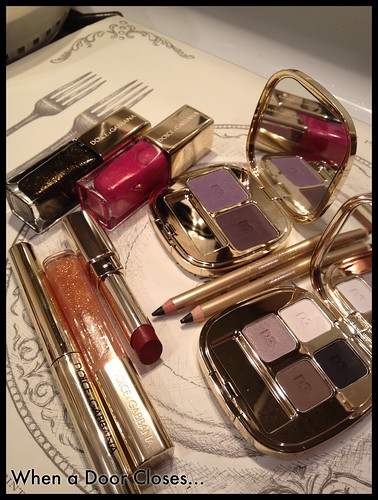
D&G 2013
 

I’ll write a full review in other posts, after I’ve had a chance to take decent photos, but will say that the taupes in the quad are a good match for my skin tone, which is unusual.  Most taupes just look like a blot of gray on my eyelids, but these look like a natural enhancement – i.e. actual shadows.  The green eyeliner works surprising well with the taupes, giving them a different look.  The concealer is the best I've used, and as others have said, the Passion Duo lipstick is luscious. 

Naomi Yasuda, celebrity manicurist and creator of Barneys Lady Gaga Nail Collection, was giving free D&G manicures that day.  Many of her nail designs are over the top for me, but she gave me a pretty lace and crystal manicure, which I will remove with great reluctance.
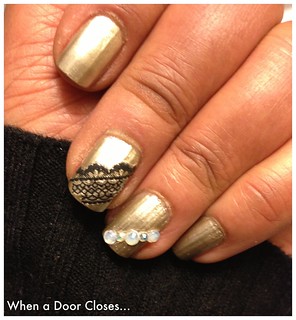
 

Naomi Yasuda D&G Mani
the crystals are not as milky as they appear in the photo.
 
I visited several Sephoras (they all seem to have different stuff).  The Times Square store had nail stations stocked with a variety of polishes and removers where customers can try on different looks.  I wish the Sephoras here had those. The stations were a mess thus no photos.  The stores in Time Square were just as crowded as the Square itself; Sephora did not seem to be sufficiently staffed to keep things in order.  The Soho store was just as crowded, but clean; had no nail bars, but they did have Edward Bess.  I wanted to look at his new eye shadow quads in person after seeing them all over the Net.  Given that eyeshadows look different on the eyelid than on the back of one’s hand, I should have tried them on, but they looked dupable out of my own stash, so I passed on them. 
 
The Meatpacking District Sephora was very elegant, which is not a characteristic that comes to my mind when I think of Sephora.  I should have taken photos, but I got totally caught up Diane’s makeover, then by actually looking around.  The store was bright enough to properly show the products, but not starkly bright like other Sephoras.  The walls were dark and potted orchids were scattered about.  Applicators and cleansers discretely placed around displays - so discrete they were almost invisible.  There were no cashiers; each sales assistant had an iPhone equipped with a price scanner and a credit card swiper.  Like the other stores, they carried Dolce and Gabbana and Giorgio Armani (surprise! I didn’t know Sephora carried Armani cosmetics).  Diane, who is not a makeup junkie, needed some basic products that she can apply easily and quickly with little fuss.   A sales assistant listened carefully to our requests and explanations, then sat her down at one of several clean and neat, mirrored stations and brought out some products out for us to consider. Here's what she got:

 
 
Diane's stuff  
From top left:  Marula Facial Oil; Hourglass Illume Creme-to-Powder Bronzer Duo; Bite Lipstick; Fresh Sugar Lip Treatment; Makeup Forever eye pencil; Anastacia tinted brow gel; Dr. Jart+ Waterfuse Smart Gel (BB Cream)
 
The sales assistant was very good.  As Diane commented, she really heard what we said, and nailed suitable colors for Diane at the first go.  We were really impressed.  I enjoyed helping Diane navigate products, decide what she really wanted and would use, and make recommendations.  Now I want to shop for my other friends! 
I bought a couple of things there for myself too, and at Inglot, which I will review later. 

I did not see my DC knitting pals; I know that some stayed in Washington for Inauguration events.  Did you go to Vogue Knitting Live?  What did you think? 

Wednesday, December 08, 2010

Shirley Paden's Design Class (or... It's All About the Numbers)

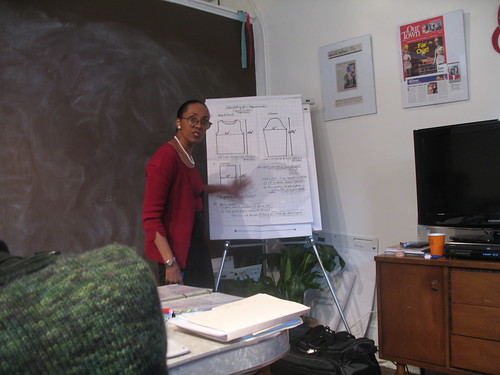
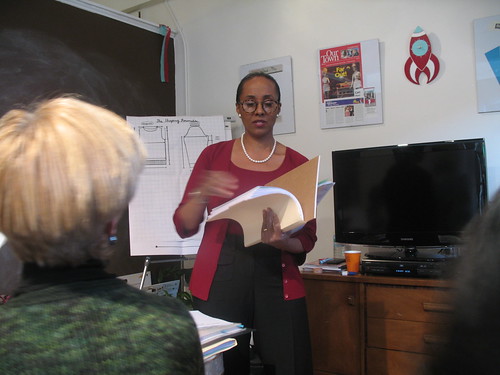
I took Shirley Paden's Knitwear Design class at  fibre space last Saturday. I had unknowingly followed her designs for years, i.e. I loved many of her designs before I knew who had designed them. So I jumped at the chance to take a design class from her. We were told before the class that we would learn how to construct two types of pullovers, a round neckline with a Classic Body silhouette, which does not have any body shaping; and a V neckline with a double tapered body silhouette, which is shaped along the natural curves of the body. To prepare for the class we were asked to select a sweater silhouette, sketch a garment, select a stitch pattern and yarn. Finally, we were to knit one or two 8”x8” swatches, which Shirley calls “meaningful swatches” that achieve a more accurate garment knitting gauge.

Shirley showed her VideoBio (Click on Press, then Video/TV) at the beginning of the class, which included photos of her work and explained what motivates her and how she designs. Then she asked us what we hoped to achieve in the class. Most of us were interested in learning how to make patterns fit. Though we had been told that we would walk through accurately measuring a swatch, taking body measurements, writing a pattern, calculating yarn amounts, and measuring a garment, I don’t think any of us expected that we would spend a day crunching numbers without knitting a stitch! But in retrospect, we should have.

IMG_1301

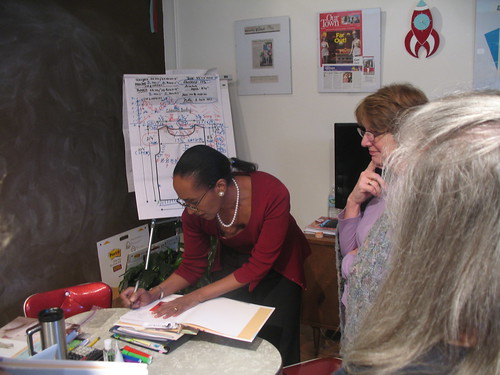
We paired off to take each other’s measurements, then Shirley began teaching us the formulas, asking us to do the math to determine the number of stitches and rows for a garment, the formulas to calculate decreases and increases for body and neck shaping, and armholes, and for a long sleeve. Someone (not me!) commented that there were computer applications to determine these things, which Shirley ignored. We spent the morning with our calculators. Danielle, fibre space’s owner, brought in a tasty lunch for us from a local organic deli, cupcakes for desert, and coffee. Shirley autographed our books, then we got back to the number crunching.

IMG_1304

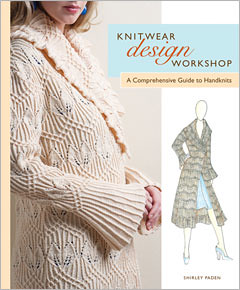
My brain was fried from too many numbers and too little yarn by 3pm, at which point I stopped trying to follow the calculations and just watched the others. I reasoned that I could refer to Shirley's book, Knitwear Design Workshop, to figure out what I didn’t understand.

SP book II


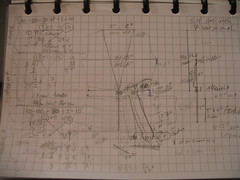
I have to admit I got testy – had I paid good money just to take a math class? That long forgotten math-challenged fourth grader made her presence known! Shirley sensed this – she gave us a break from the numbers and told us a bit about her custom design business and shared some war stories.  She will design and knit a garment specifically for you for a fee; she always has several projects in the works; though she knits much of her work herself, she employs several knitters to help out, otherwise she'd never make money. Shirley also showed us an intensely detailed notebook dedicated to one design. No one asked why much of it was hand written, but it makes sense: if you are sketching something by hand, it’s handy to run the numbers by hand also. Perhaps she scans them into a computer system later. She resumed instruction by showing us the calculations for designing a set-in cap sleeve.

Looking at Shirley’s notebook was inspiring. I enjoyed looking at her handwritten notes, and sketches of stitch patterns. It was just the break needed for a visually-oriented person like me. She didn’t have completed garments with her (it wasn’t a trunk show after all!), which would also have kept me going over the course of the day. I suggested that she use photos of her known designs to illustrate teaching points.

Maybe because several of us were math challenged, thus slowing the pace a bit, we never got to apply the formulas to our sketches in class. Nor did we learn how to determine the amount of yarn a project requires - maybe Shirley tactfully skipped this part because it was obvious that most of us had not measured out our remaining yarn before hand as instructed. She did attempt to show us how to factor stitch patterns into a design, but I think she got too many deer-in-the-headlights looks to pursue this line of instruction! No worries – it’s in the book.

So, you’re probably wondering if I thought the class was worth taking. The answer is a resounding “yes.” And I would like to take several others.  First of all, I had not taken my measurements for years. In fact, I don’t know that I had ever taken detailed measurements such as shoulder width, armhole depth, raglan depth, neck width and depth, back and front torso length, wrist and knuckle, and a few others. Shame on me, but there it is. In addition to executing one’s own design, knowing the formulas is handy for those who want to alter patterns designed by others. I would never have thoroughly read through them in the book on my own (shame on me again…)  It would have been nice to have them before working on one of my current designs which includes an angled armhole. It turned fine, but having the formulas would have saved some time. Despite being pretty drained after class, I went home, ate dinner, rested a while, then plugged in the numbers for my design based on my measurements and desired silhouette, and cast on, working late into the night.

IMG_1302 (2)

Shirley gave us a hefty number of helpful handouts that I referred to in addition to the book.  The teaching charts you see in the photos were included in the handouts as well as detailed illustrations showing how to properly measure oneself.  The book is a very instructive how-to and reference tool: there are chapters dedicated to every aspect of garment design from necklines to armholes, neckbands, collars, and lapels, a range of silhouettes, choosing yarn,  finishing techniques and more. It focuses on detail more than most other knitting books I've seen, and is perfectly organized.  It was interesting to hear that Shirley eagerly collects stitch pattern books, style and knitting books, and subscribes to a number of publications dedicated to predicting fashion styles and colors of the upcoming seasons (what are those called?)

IMG_1300

She confirmed that there is a lot that a designer must work out on her own, by trial and error. Like the character of specific types of yarn and how they might behave in a pattern, though she also covers a bit of this in the book. And of course a designer must find her own inspiration.

Shirley Paden teaches classes in her hometown New York City and has a full book promotion and traveling class schedule. You can find her class schedules, Video Bio, and portfolio on her site.  She recently completed a very successful Webinar. Those of you who can't take her class should keep an eye on her site and the  Ravelry group,  We Love Shirley Paden! for announcements of other Webinars.

ShareThis

Related Posts Plugin for WordPress, Blogger...